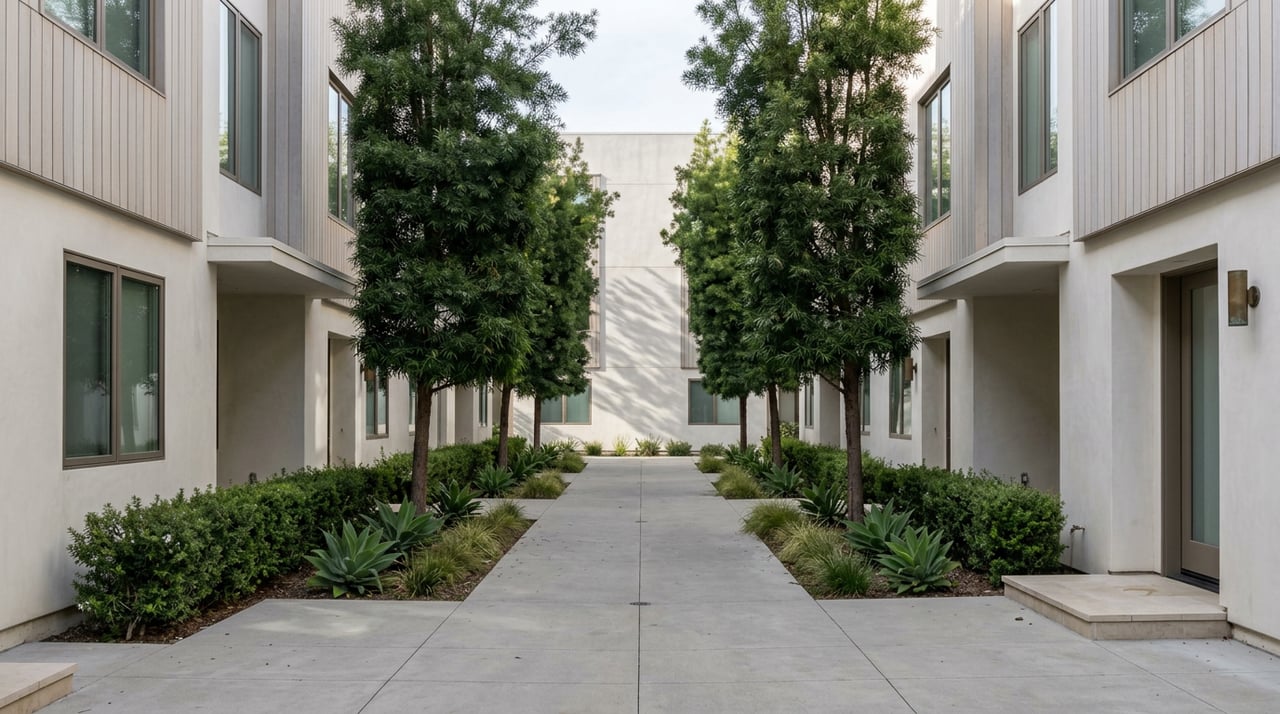
Say you're comparing two Playa Vista condos. Same square footage, same building era, same walk to the Runway shops. One lists for $850,000. The other, a few blocks over, lists for the same price. Your agent runs comps, your lender runs numbers, everything lines up. Then underwriting flags a line item on one property that never showed up on the other: an annual special tax tied to a Community Facilities District, and it's about to change your monthly payment and possibly the loan amount you qualify for.
This is the moment most Playa Vista buyers first encounter Mello-Roos, and it usually happens later than it should. Not at the open house. Not in the listing description. In escrow, or worse, during underwriting, when a lender's debt-to-income math suddenly has a new input.
Here's the part that actually matters for anyone shopping this neighborhood: whether that tax applies to a given unit isn't random, and it isn't tied to price. It's tied to which phase of Playa Vista the parcel sits in, and within that phase, to square footage. Two units that look identical on paper can carry a meaningfully different true carrying cost, and the difference is baked into how the community was financed twenty-five years ago, not into anything you'll see in a walkthrough.
Why the tax exists in the first place
Playa Vista's infrastructure, its streets, storm drains, and street lighting, didn't build itself. When Proposition 13 capped standard property tax rates at 1% back in 1978, cities lost a major funding source for new development infrastructure. Mello-Roos, formally the Community Facilities Act of 1982, gave developers and local governments a workaround: form a Community Facilities District, issue bonds against future property owners' taxes, and use the proceeds to build the roads, sewers, and parks a new community needs before anyone moves in.
Playa Vista's version is Community Facilities District No. 4, formed by the City of Los Angeles in 1999 to finance Phase I of the development. In a special landowner election held in 2000, the tax was unanimously approved, which sounds like a strong mandate until you realize the "landowners" voting were largely the developer itself, since almost no one lived there yet. In 2003, the city issued $135 million in Mello-Roos bonds against that district, generating $102 million to fund public infrastructure across the community.
The single largest project funded by those bonds was the Riparian Corridor, a stormwater management and habitat restoration project running along the base of the Westchester Bluffs. That project came with an unusual complication. Construction crews encountered Native American remains during excavation, tied to the site's history as a Gabrielino Tongva burial ground uncovered decades earlier during Howard Hughes's aviation operations. The archaeological work required to handle that discovery properly ran well over budget, and in 2007 the Los Angeles City Council approved an additional $11.4 million reimbursement to Playa Vista's developer to cover it, paid out of the same Mello-Roos bond proceeds.
That history matters for one practical reason: it explains why the tax exists, why it's tied to Phase I specifically, and why it isn't going anywhere until those bonds are retired.
Phase I pays it. Phase II doesn't.
This is the split that actually drives what you pay. Parcels in Playa Vista's Phase I, generally the older section of the community built out first, carry the CFD No. 4 special tax. Parcels in Phase II do not, because the developer financed that later infrastructure differently, folding the cost directly into the original sale prices of Phase II homes rather than levying an ongoing district tax.
The result is two units that can look interchangeable on a listing sheet but carry genuinely different long-term costs. A Phase II buyer pays more upfront, in theory, but never sees a CFD line item. A Phase I buyer may see a lower sticker price but owes an annual special tax on top of it, indefinitely, until the bonds are paid off.
For the 2025-26 fiscal year, actual parcel-level special tax levies for Phase I properties documented in city filings run in a range that includes figures like $1,365.69 and $2,454.09 annually, depending on the unit's square footage. That works out to roughly $114 to $205 a month, tacked onto principal, interest, standard property tax, and HOA dues. It isn't calculated as a percentage of your purchase price the way your base property tax is. It's set by a formula tied to the physical size of your unit, which means it doesn't shrink if you negotiate the price down, and it doesn't grow just because the market run-up pushed comparable sales higher.
Across Southern California's CFD-heavy master-planned communities generally, lending industry guidance published in 2026 notes that effective property tax rates, meaning the base 1% plus every local special tax layered on top, can reach 1.5% to 1.7% of purchase price in districts like this, compared to roughly 1.1% to 1.3% in areas without a CFD. That's the gap between what a buyer assumes their tax rate will be and what it actually is once the CFD line item is added in.
The fee nobody mentions until the closing statement
Mello-Roos isn't the only Playa Vista-specific cost hiding outside the standard cost sheet. Separately, when a home sells in Playa Vista, 0.75% of the purchase price is paid to Playa Vista Community Services, the nonprofit that funds the community's shared programming: the concerts in the park, outdoor movie nights, and a portion of ongoing conservation work along the Ballona Wetlands. This is a one-time transfer fee, not an annual tax like Mello-Roos, and unlike the CFD levy it isn't fixed by law as to who pays it. Depending on market conditions at the time of sale, the fee can fall to the seller, the buyer, or get split between them. Historically sellers have tended to absorb it, but that's a negotiated point, not a guarantee, and it's worth putting on the table explicitly rather than assuming.
What this changes at the negotiating table
None of this means Phase I is a worse buy or Phase II is automatically the safer one. It means the sticker price on a Playa Vista listing tells you less than it would in most other Westside neighborhoods, and the gap gets filled in by documents most buyers don't ask for until an agent or lender makes them.
Before writing an offer on a specific address, here's what actually closes that gap:
- Confirm the parcel's phase and, if it's Phase I, request the current fiscal year's CFD No. 4 special tax amount tied to that unit's exact square footage rather than relying on a building-wide estimate.
- Ask whether bonds on that parcel's tax are scheduled to escalate, since Mello-Roos levies can increase annually up to a capped rate, and confirm how many years remain before the bonds are retired.
- Get a straight answer on who's expected to cover the 0.75% Community Enhancement Fee before you're staring at a closing statement.
- Make sure your lender's pre-approval already reflects the special tax as part of your monthly housing cost, since it counts in debt-to-income calculations the same way a mortgage payment does and can affect how much loan you actually qualify for.
If a unit's true carrying cost runs a few hundred dollars a month higher than a comparable listing without the CFD tax, that's a legitimate point in your favor at the offer table, not a reason to walk away. Buyers who know the number going in are the ones who negotiate price or credits around it instead of discovering it as an unpleasant surprise weeks before closing.
FAQ
Is Mello-Roos tax deductible on my federal return? Generally no. Because it's a flat parcel-based special tax rather than a tax based on assessed value, it typically doesn't qualify as a deductible ad valorem property tax. The federal SALT cap rose to $40,000 for 2026, which helps some California homeowners with other deductions, but it doesn't change the underlying rule on whether Mello-Roos itself qualifies. Confirm your specific situation with a tax professional.
Does Phase II have any special assessments at all? Phase II parcels generally don't carry the CFD No. 4 special tax that applies to Phase I. That infrastructure cost was built into original sale prices instead of levied annually, though every buyer should still confirm the specific parcel's status rather than assuming based on the building's general reputation.
Will my CFD tax go up every year? It can, but only up to whatever cap is written into the district's formation documents, which typically limit annual increases to a fixed percentage. The exact ceiling and remaining bond term are public record and worth requesting directly rather than assuming.
How do I find the exact number for a specific unit? The current levy shows up as its own line item on the Los Angeles County secured property tax bill for that parcel, tied to CFD No. 4. Preliminary title reports during escrow will also reference any recorded special tax lien.
Playa Vista rewards buyers who ask about the numbers behind the number. If you're comparing units across Phase I and Phase II, or you want a straight read on what a specific address will actually cost you month to month, Bill Ruane has spent years walking South Bay and Westside buyers through exactly this kind of due diligence. Let's Connect.