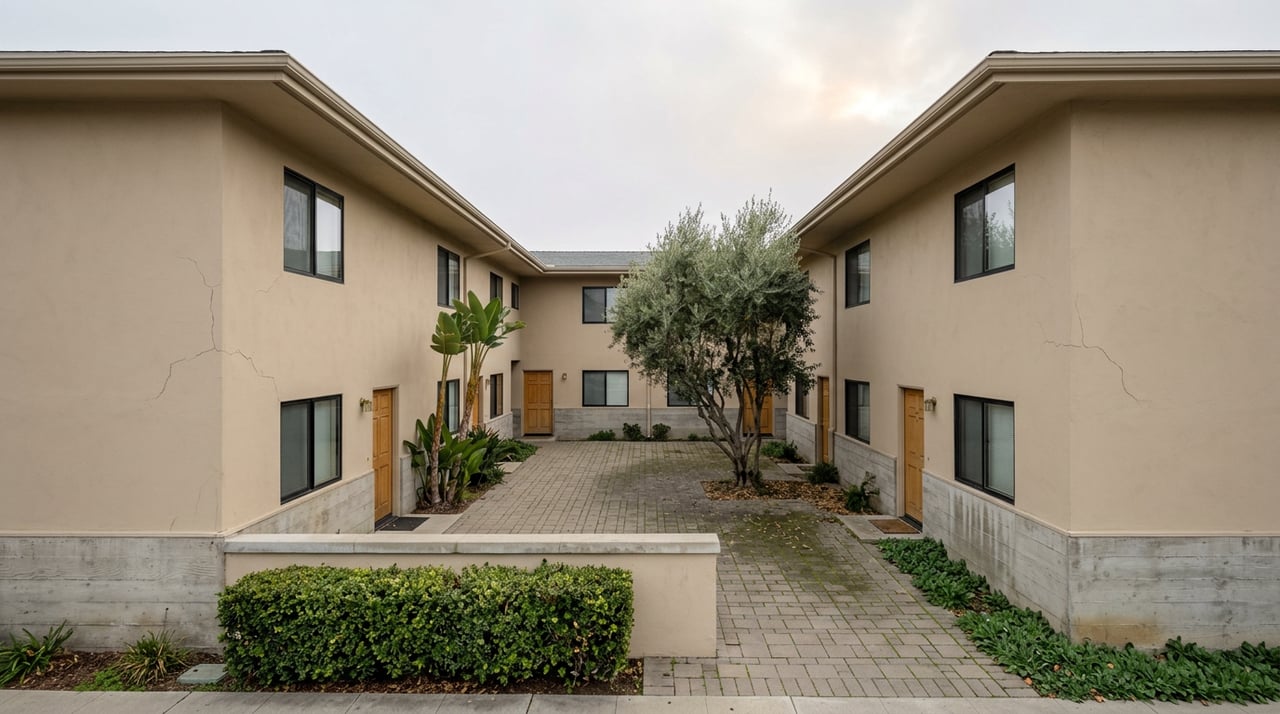
Ask a Culver City apartment owner what their rent control ordinance costs them and most will quote a percentage: a Consumer Price Index-based cap that has run near 3 percent a year and, as of the city's most recent published schedule this year, sits capped at 3.25 percent. That number gets repeated in every landlord guide, every buyer's first phone call to a broker, every conversation that starts with "how bad is rent control here." It is also the wrong number to fixate on if you are trying to figure out what a specific building is worth.
The mechanism that actually prices a covered Culver City building is not the cap. It is Costa-Hawkins vacancy decontrol, the state law that lets an owner reset a unit to market rent the moment a tenant leaves voluntarily. Two buildings on the same block, same vintage, same unit count, can carry meaningfully different values because one has had normal tenant turnover over the past decade and the other has tenants who moved in during the Clinton administration and have no reason to leave. The cap applies equally to both. The economics do not.
What the ordinance actually covers
Culver City's Rent Control Ordinance and its companion Tenant Protections Ordinance became permanent on October 30, 2020. Coverage is narrower than most sellers assume. A unit is subject to the local cap only if it sits in a building with two or more units and carries a certificate of occupancy issued on or before February 1, 1995. Single-family homes, condominiums, and townhomes are exempt regardless of age, because California's Costa-Hawkins Rental Housing Act blocks any city from applying local rent control to those property types. Buildings that received their certificate of occupancy after February 1995 are exempt too, though they may still fall under the statewide Tenant Protection Act of 2019 once they pass 15 years of age.
That cutoff date is the first thing to confirm before anyone prices a deal, and it is also the detail buyers most often skip. A building's construction date on a listing sheet is not the same as its certificate of occupancy date, and the difference determines whether you are underwriting a capped asset or a market-rate one.
The ordinance itself was amended on January 12, 2026, when the City Council adopted a round of clarifying revisions. The most consequential change for owners: announcements of the Annual Maximum Permissible Rent moved from a monthly cadence to a single annual announcement, a change that took effect July 1, 2026 and is now in place for the current cycle. Council also carved out an exception in the owner-occupancy policy so smaller landlords can move themselves or a relative into a unit they own without running into the same restrictions built for larger operators, a change that had been debated at a council meeting the previous November after residents and council members flagged how the original language handled CPI-based calculations.
The lever nobody prices correctly
Here is the part that separates a well-informed buyer from one who is guessing. The Costa-Hawkins vacancy decontrol right means that when a covered unit turns over because a tenant chooses to leave, the owner may reset that unit's rent to whatever the market will bear for the next tenant. The new tenancy then falls under the annual cap going forward, but the reset itself is a right no local ordinance can take away.
That single mechanism explains why a building's rent roll matters more than its rent cap. A six-unit building where every tenant has stayed for fifteen years is locked into base rents that may sit far below market, with no legal path to close that gap short of a tenant choosing to move. The same six-unit building two doors down, with turnover every three or four years, has been quietly resetting toward market rent the entire time. Both buildings are subject to the identical 3.25 percent annual cap. Their actual net operating income, and therefore their value, can diverge by a wide margin.
The other lever is the Ellis Act, the state law that lets an owner exit the rental business entirely, whether to redevelop, sell the property vacant, or convert its use. Culver City layers its own filing and notice requirements on top of the state process, so the two have to be run together rather than treated as a single form. For an owner weighing whether to sell as-is with tenants in place or to Ellis Act the building first, that local layer changes both the timeline and the number a buyer will actually offer.
What this changes at the closing table
Due diligence on a covered Culver City building looks different from due diligence on a market-rate purchase, because the buyer inherits the seller's rent history along with the property. Before anyone signs, the list to work through includes:
- The certificate of occupancy date, which decides whether the ordinance applies at all
- A certified rent roll listing the legal base rent for every unit, not just current collected rent
- Confirmation that every unit is registered with the city and current on fees, since registration is due annually
- Estoppel certificates from tenants and copies of every rent increase notice served in recent years
- Any correspondence with the city's Landlord-Tenant Mediation Board or code enforcement
An underregistered building is not a paperwork inconvenience. A landlord who has not properly registered a unit is barred from demanding or accepting rent for it, which means a new owner can inherit a building where the ability to raise rent is frozen from the day title transfers, through no fault of their own underwriting.
What the price data actually says
Culver City apartment buildings currently trade at cap rates ranging roughly from 3.61 percent to 6.42 percent, a wide band that reflects exactly the variation described above. Zoom out and the Los Angeles multifamily market as a whole averaged a 5.6 percent cap rate across all building classes in the first quarter of 2026, following a roughly 9 percent rise in average cap rates during 2025 as financing costs reset expectations after the compressed rates of 2021 and 2022. Multi-year data compiled from CoStar covering 2020 through 2025 puts the average Culver City apartment sale near $310,000 per unit.
| Submarket | Typical cap rate range |
|---|---|
| Beverly Hills / West Hollywood | 3.5% to 5.0% |
| Coastal Westside | 4.0% to 5.25% |
| Culver City | 3.61% to 6.42% |
| South Bay / Long Beach | 5.0% to 6.5% |
Culver City's wide range sits between the tightest Westside submarkets and the higher-yield South Bay, which tracks with a market that has moved from a secondary option to what some brokers describe as a first-call destination, driven by a media and production employment base anchored by Sony Pictures Studios and a growing footprint from Amazon Studios and Apple TV+ production activity, plus a downtown core reshaped by the Culver Steps redevelopment. Buyer depth in that market includes private investors, 1031 exchange buyers, and value-add operators, and there is particular demand right now for smaller buildings where a local operator can close with certainty.
None of that pricing context changes the underlying point. Within that cap rate band, the buildings commanding the tighter end are the ones with documented turnover, current registration, and a rent roll a buyer can underwrite without guessing. The buildings trading toward the wider end are frequently the ones where the paperwork is thin or the tenancy is long and static, regardless of how the building looks from the street.
FAQ
Does Measure ULA apply if I sell a Culver City apartment building? No. Measure ULA's transfer tax surcharge applies only to property transfers within the City of Los Angeles. It does not apply in Culver City, Beverly Hills, Santa Monica, West Hollywood, Inglewood, Long Beach, or any other independent municipality. A seller in Culver City does not face that surcharge, even on a building a few blocks from a Los Angeles city boundary.
Is a duplex or triplex in Culver City automatically rent controlled? Only if it received its certificate of occupancy on or before February 1, 1995 and is not otherwise exempt. Single-family homes, condominiums, and townhomes are never subject to Culver City's local ordinance, no matter how old they are, because Costa-Hawkins blocks local rent control from applying to those property types statewide.
What if my building is just outside Culver City's boundary? Confirm jurisdiction before you assume anything. A building one block into the City of Los Angeles falls under LARSO instead, which covers buildings built on or before October 1, 1978 under a different cap structure entirely. That LARSO cap held at 3.0 percent through June 30, 2026 and has since shifted to a formula tied to 90 percent of local CPI, with a 1 percent floor and 4 percent ceiling. Los Angeles County has at least eight distinct rent control frameworks depending on exact location and build date, and Culver City-adjacent is not the same as Culver City for any of these purposes.
Whether you are buying your first small multi-unit property or preparing to sell a building your family has held for decades, the details above are the ones that actually move the number on the closing statement. If you want a second set of eyes on what your Culver City building is really worth, or what a covered property should trade for before you list it, Bill Ruane has spent decades working South Bay and Westside transactions where the paperwork matters as much as the address. Let's Connect.